“Mercury is the hottest, the coldest, a true healer, a wicked murderer, a precious medicine and a deadly poison, a friend that can flatter and lie.” – Woodall from The Surgeon’s Mate, London, 1639
The Quicksilver Tri-Test is quite simply the most versatile diagnostic test available to determine exposure of various species (types) of mercury, and your individual ability to excrete both types of mercury.
|
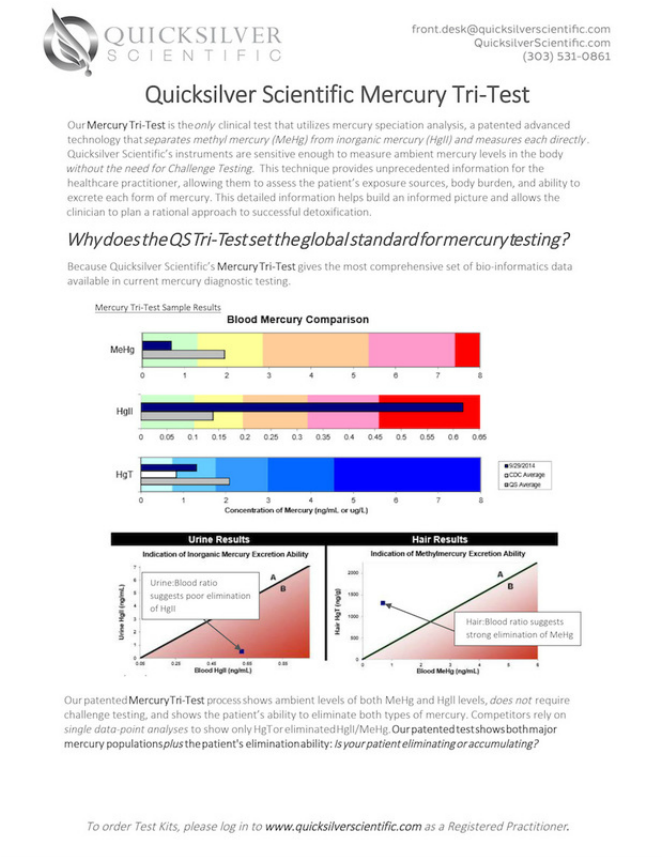
Clinical Description: The Quicksilver Mercury Tri-Test is the only clinical test that utilizes mercury speciation analysis, a patented advanced technology that separates methyl mercury (MeHg) from inorganic mercury (HgII) and measures each directly. Quicksilver Scientific's instruments are sensitive enough to measure ambient mercury levels in the body WITHOUT THE NEED FOR CHALLENGE TESTING. This laboratory test provides unprecedented information for the healthcare practitioner, allowing them to assess the patient’s exposure sources, body burden and ability to excrete each form of mercury. This detailed information helps build an informed picture and allows the clinician to plan a rational approach to successful detoxification strategy for the patient.
What about Mercury Challenge Testing? In the 1990’s, sensitivity of analytical equipment was not advanced enough to measure ambient (steady state) blood mercury levels. Therefore, “challenge” or “provocation” testing, using high doses of strong chelation agents, was developed to “pull” mercury out of organic cellular structure for urinary analysis under the diagnostic premise that it shows the mercury “body burden” of an individual and establishes correlation of long-term mercury burden. While mercury challenge testing was clinically relevant for the time, advances in technology and clinical study have proven challenge testing to be unreliable and even potentially damaging to the patient. Problems associated with challenge testing include:
|